Skip to content

Back

Fishing in Townsville

Grab a rod, find a spot, meet the locals.

Meet the fishFind a spot

Meet the fish

Tap a photo. Before you keep a fish: check the official species guide (opens in a new tab)(qld.gov.au).

  • Barramundi, Lates calcarifer, shown in profile

    Barramundi

    Lates calcarifer. Also called Barra, Giant perch.

    Try:Riverway, Ross Creek

    Look for
    A silver fish with an olive-grey or blue-grey back, plain fins without markings, and eyes that shine red-gold in light.
    Where it lives
    Adults live mostly in estuaries, around mangroves and river mouths. Young fish move up rivers into fresh water, and barramundi are stocked in some dams and weirs.
    Tips
    Often fished around snags, rock bars and creek mouths with lures or live bait, especially around the change of tide. Barramundi are strong, so people use heavier line.
    Before you keep one
    Barramundi has an east coast closed season over summer, and an upper and lower size limit. In the Ross River weirs you also need a SIPS permit. Read the closed season card on this page.

    Photo: Salil Kumar Mukherjee, CC BY-SA 4.0. All credits
    Log a barramundi in My Catch

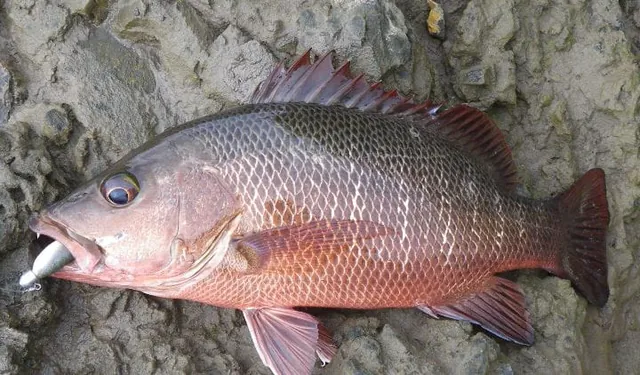
  • A caught mangrove jack on grey rock, with a reddish-bronze body and a spiny red back fin.

    Mangrove jack

    Lutjanus argentimaculatus. Also called Jack, Red bream.

    Try:Ross Creek

    Look for
    Greenish-brown to reddish back and sides, a long snout and large canine teeth. Young fish have pale bars on their sides and blue lines on the cheeks.
    Where it lives
    Young fish and young adults live in mangrove estuaries and the lower parts of freshwater streams. Larger adults move out to deeper reefs.
    Tips
    Often fished close to snags, mangrove roots and rock walls. A hooked jack heads straight for cover, so people fish with firm drag and strong leader.
    Before you keep one
    Has its own minimum size and possession limit. Snags and deep edges are crocodile habitat too.

    Photo: Soroi Gamoga, used with permission.All credits

    Log a mangrove jack in My Catch

  • Dusky flathead, Platycephalus fuscus, resting on sand between red seaweed

    Flathead

    Platycephalus fuscus (dusky flathead). Also called Dusky flathead, Mud flathead, Bartail flathead.

    Try:The Strand, Pallarenda, Bushland Beach, Saunders Beach

    Look for
    A flat, blotchy brown fish that matches the sand or mud it lies on. Dusky flathead have a large dark blotch on the tail and a pale pink underside to the head.
    Where it lives
    Estuaries and coastal bays, lying on sand, mud, gravel and seagrass, often at the edge of channels and drop-offs.
    Tips
    Flathead wait on the bottom for food, so people slowly work soft plastics or baits along sandy edges, often on a falling tide.
    Before you keep one
    Several flathead live here and their rules differ. Dusky flathead have an upper and lower size limit, so identify the fish before keeping it.

    Photo: Richard Ling, CC BY-SA 2.0. All credits

    Log a flathead in My Catch

  • Pikey bream, Acanthopagrus pacificus, swimming among mangrove roots in an aquarium

    Bream

    Acanthopagrus pacificus (pikey bream). Also called Pikey bream, Black bream, Yellowfin bream.

    Try:Ross Creek

    Look for
    Pikey bream are grey to dull olive-brown with a silver sheen, blackish soft fins and thick spines on the back fin. Yellowfin bream are similar, with yellow fins underneath.
    Where it lives
    Common in estuaries in northern Queensland, feeding near the bottom over rough or muddy ground, rock walls and mangroves.
    Tips
    A good fish for beginners. People use small hooks with prawn, yabby or small soft plastics near rocks, pylons and mangrove edges.
    Before you keep one
    Pikey and yellowfin bream share a combined possession limit and have a minimum size.

    Photo: タウナギ, CC0 1.0. All credits

    Log a bream in My Catch

  • Northern whiting, Sillago sihama, shown in profile

    Whiting

    Sillago sihama (northern whiting). Also called Northern whiting, Sand whiting, Goldenline whiting.

    Try:The Strand, Pallarenda, Bushland Beach, Saunders Beach

    Look for
    A slim, sandy-brown to honey-coloured fish, pale below, usually with a silver band along each side.
    Where it lives
    Shallow water near the shore: beaches, sandbars, mangrove creeks and estuaries.
    Tips
    People fish for whiting on sandy flats and beaches with light line and small baits such as worms or yabbies, often as the tide rises.
    Before you keep one
    Some whiting share a combined possession limit and have a minimum size.

    Photo: Rooiratel, CC BY 4.0. All credits

    Log a whiting in My Catch

  • Giant trevally, Caranx ignobilis, swimming over a sandy sea floor

    Trevally

    Caranx ignobilis (giant trevally). Also called Giant trevally, GT, Golden trevally.

    Try:Ross Creek, The Strand, Cape Pallarenda, Saunders Beach

    Look for
    Giant trevally are silver-grey with a darker back and a steep, rounded head. Young fish are more silver with paler fins. There are many kinds of trevally.
    Where it lives
    All kinds of coastal water. Young trevally often come into estuaries and around jetties, and adults roam reefs and open water.
    Tips
    Trevally chase moving bait, so people cast and quickly retrieve metal lures or surface lures, often around jetties, rock walls and channel edges.
    Before you keep one
    Most trevally share one combined possession limit. Identify the fish first.

    Photo: Dwayne Meadows, NOAA/NMFS/OPR, Public domain. All credits

    Log a trevally in My Catch

  • Barred javelin, Pomadasys kaakan, shown in profile against a black background

    Spotted grunter

    Pomadasys kaakan (barred javelin). Also called Barred javelin, Javelin fish, Grunter bream.

    Try:Pallarenda, Bushland Beach

    Look for
    A golden-green back and silvery belly. While alive, faint brown spots line up in vertical bars along the sides. Often confused with the silver javelin. Not the same fish as the freshwater barred grunter.
    Where it lives
    Inshore coastal water, open bays and estuaries, and up rivers as far as the water stays brackish.
    Tips
    People fish for grunter on sand and mud flats and in channels, often with prawn or yabby baits on the bottom around the turn of the tide.
    Before you keep one
    Has its own minimum size and possession limit, including a fillet length rule on boats.

    Photo: Dinh D. Tran, FiMSeA, CC BY 3.0. All credits

    Log a spotted grunter in My Catch

  • Giant queenfish, Scomberoides commersonnianus, swimming underwater with dark blotches along its side

    Queenfish

    Scomberoides commersonnianus (giant queenfish). Also called Giant queenfish, Queenie, Leatherskin.

    Try:The Strand, Cape Pallarenda

    Look for
    A long, flat-sided fish with a dusky green to bluish back, a silver belly and five to eight large dull blotches along each side.
    Where it lives
    Common along the northern Queensland coast around reefs, headlands and islands, and sometimes in estuaries.
    Tips
    Queenfish are fast and often jump. People cast lures around jetties, headlands and moving water, and handle them carefully because of sharp spines near the back.
    Before you keep one
    Has its own minimum size and possession limit.

    Photo: portioid, CC BY-SA 4.0. All credits
    Log a queenfish in My Catch

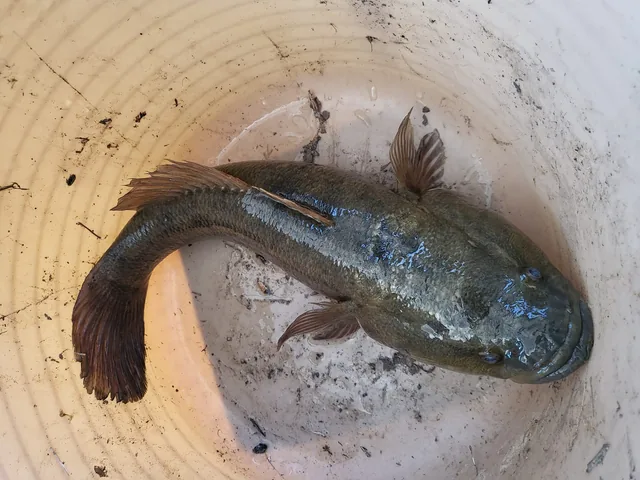
  • A sleepy cod with a broad flat head and dark olive-brown body, lying curved in the bottom of a white bucket.

    Sleepy cod

    Oxyeleotris lineolata. Also called Sleeper.

    Try:Riverway

    Look for
    A long fish with a flattened head, dark to light brown with spotted fins. It often rests still on the bottom.
    Where it lives
    Quiet, weedy and timbered fresh water. It is stocked in some northern dams and is one of the fish most often recorded in the Ross River catchment.
    Tips
    People fish slowly near snags and weed beds, with small live baits or lures worked close to the bottom, often around dusk.
    Before you keep one
    Has a possession limit in fresh water.

    Photo: local angler, used with permission.All credits
    Log a sleepy cod in My Catch

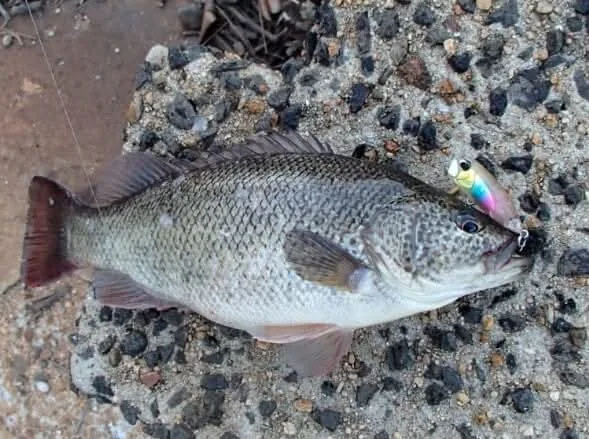
  • A spangled perch with silver-grey scales and small dark spots, lying on gravel with a small lure in its mouth.

    Spangled perch

    Leiopotherapon unicolor. Also called Spangles, Jewel perch.

    Try:Riverway

    Look for
    A small silver-grey perch covered in small rusty or orange spots.
    Where it lives
    Almost any fresh water, from big river pools to small creeks and farm dams. It is recorded in the Ross River catchment.
    Tips
    A good first fish for children. Small hooks with worms, prawn or bread catch them close to the bank.
    Before you keep one
    Has a possession limit in fresh water.

    Photo courtesy of landangler.net (opens in a new tab), used with permission.All credits

    Log a spangled perch in My Catch

  • Historic side-view illustration of a barred grunter, Amniataba percoides

    Barred grunter

    Amniataba percoides. Also called Banded grunter.

    Try:Riverway

    Look for
    A small, deep-bodied fish with dark vertical bars. Young ones look like young tilapia, but barred grunter have a clear dip between the front and back of the back fin, and the end of that fin is rounded, not pointed.
    Where it lives
    Rivers, weir pools and creeks in fresh water. It is recorded in the Ross River catchment.
    Tips
    Caught on small baits such as prawn or worms near the bank and around weed beds.
    Before you keep one
    Has a possession limit. Check it is not a tilapia before you let it go: tilapia must never go back in the water.

    Photo: James Douglas Ogilby and Allan Riverstone McCulloch, Public domain. All credits

    Log a barred grunter in My Catch

  • Sevenspot archerfish, Toxotes chatareus, swimming in shallow water

    Archerfish

    Toxotes chatareus (sevenspot archerfish). Also called Sevenspot archerfish, Common archer fish.

    Try:Riverway

    Look for
    A deep-bodied silver fish with a row of dark spots along its back. It shoots jets of water at insects above the surface.
    Where it lives
    Fresh and brackish water in rivers, weir pools and mangrove creeks, often under overhanging plants.
    Tips
    Small lures, flies or baits cast close under overhanging branches, near the surface.
    Before you keep one
    Has a possession limit.

    Photo: Abu Hamas, CC BY-SA 4.0. All credits

    Log a archerfish in My Catch

  • Freshwater longtom, Strongylura krefftii, swimming near the surface with its long narrow jaws visible

    Freshwater longtom

    Strongylura krefftii. Also called Fitzroy garpike, Longtom.

    Try:Riverway

    Look for
    A long, slender silver or olive-green fish with long jaws full of sharp teeth.
    Where it lives
    River channels, lagoons, muddy creeks and billabongs, often near water plants. It also lives in brackish water.
    Tips
    Longtom chase small, fast lures near the surface. Use pliers to unhook them, because of the sharp teeth.
    Before you keep one
    Has a possession limit.

    Photo: coenobita, CC BY 4.0. All credits

    Log a freshwater longtom in My Catch

  • Oxeye herring, Megalops cyprinoides, shown side-on in an aquarium

    Oxeye herring

    Megalops cyprinoides. Also called Tarpon, Indo-Pacific tarpon, Bony mullet.

    Try:Riverway

    Look for
    A silver fish with a bluish-green back, large scales, a very big upturned mouth, a deeply forked tail and a long last ray on the back fin.
    Where it lives
    Adults live in the sea and estuaries. Young fish travel up tropical rivers into fresh water, coastal lakes and mangroves.
    Tips
    Tarpon jump a lot when hooked. People cast small lures or flies where they roll at the surface, often at dawn or dusk.
    Before you keep one
    Comes under the general possession limit.

    Photo: Lerdsuwa, CC BY-SA 3.0. All credits

    Log a oxeye herring in My Catch

  • Speckled longfin eel, Anguilla reinhardtii, partly submerged in a creek

    Longfin eel

    Anguilla reinhardtii. Also called Eel, Spotted eel.

    Try:Riverway

    Look for
    A snake-like fish with a small head, jaws that reach well past the eye, and dark blotches on an olive or brown body.
    Where it lives
    Flowing freshwater streams, lakes and swamps along the east coast.
    Tips
    Eels feed on the bottom, mostly at night. People use fish or meat baits in deep pools and near snags.
    Before you keep one
    Has a minimum size, and shares one possession limit with other eels.

    Photo: John Robert McPherson, CC BY-SA 4.0. All credits

    Log a longfin eel in My Catch

Fish photo credits and licences

Checked . Review due .

Freshwater records are described as recorded in the Ross River catchment. A listed fish may not be at your spot today.

Caught something you do not recognise? See pests and turtles to recognise.

Draft. Henari’s fishing tips are not reviewed by a local guide yet.

Places to fish

Map of seven fishing places around TownsvilleA simple offline map. Numbered links match the text list below. Magnetic Island is shown as an island outline. An enlarged box shows The Strand pier.Magnetic Island3. Strand pier, enlarged1234567

A simple orientation map, not a navigation chart. Use the linked text list for place details.

  1. Riverway and the Ross River
  2. Ross Creek
  3. The Strand pier
  4. Pallarenda
  5. Cape Pallarenda
  6. Bushland Beach
  7. Saunders Beach

© OpenStreetMap contributors (ODbL). Map data bundled 2026-10-25. Facilities are mapped by OpenStreetMap, please check.

Every waterway here is crocodile country, whatever the season. Be Crocwise (opens in a new tab)(qld.gov.au)

Henari has not yet confirmed the facilities marked “check”. Look at the official page or ask before you travel.

  • Ross River beside the Riverway parklands in Townsville

    Riverway and the Ross River

    Parkland and paths along the freshwater weir pools of the Ross River, with Aplins, Gleeson and Black weirs. The weir pools are among the stocked waters named in the barramundi rules.

    • Shore fishing
    • Freshwater weir

    Fish people look for here:Barramundi, Sleepy cod, Spangled perch, Barred grunter, Archerfish, Freshwater longtom, Oxeye herring, Longfin eel.

    Log a catch here

    Permit needed: You need a Stocked Impoundment Permit Scheme (SIPS) permit to fish with a line in Aplins, Gleeson’s and Black weirs. Buy one online, by phone or at some Australia Post outlets before you go. Buy a SIPS permit for Riverway and the Ross River (opens in a new tab)(qld.gov.au) · SIPS waters (opens in a new tab)(qld.gov.au)

    Take care: Banks can be steep and slippery. Crocodiles can be anywhere in the river, including near the weirs. Tilapia live here too: never put one back.

    • Toilets: check
    • Accessible path: check
    • Parking: check
    • Shade: check

    Mapped by OpenStreetMap, please check: drinking water, parking, shelter, toilets.

    Checked . Review due .

    Check details for Riverway and the Ross River (opens in a new tab)(townsville.qld.gov.au)

  • Ross Creek in Townsville with boats, mangroves and buildings along the banks

    Ross Creek

    A tidal creek through the middle of the city, with rock walls and boat moorings along its banks.

    • Shore fishing

    Fish people look for here:Mangrove jack, Bream, Trevally, Barramundi.

    Log a catch here

    Take care: Keep clear of boats and moorings. Tidal creeks are crocodile habitat.

    • Toilets: check
    • Accessible path: check
    • Parking: check
    • Shade: check

    Mapped by OpenStreetMap, please check: drinking water, parking, shelter, toilets.

    Checked . Review due .

    Check details for Ross Creek (opens in a new tab)(townsville.qld.gov.au)

  • The Strand Pier extending over Cleveland Bay at dusk

    The Strand

    The city beachfront on Cleveland Bay, with a long pier and sandy beaches.

    • Pier fishing
    • Beach fishing

    Fish people look for here:Trevally, Queenfish, Whiting, Flathead.

    Log a catch here

    Take care: The pier is busy and high above the water. Watch for walkers, cyclists and swimmers, and take a landing net or gaff with a long handle.

    • Toilets: check
    • Accessible path: check
    • Parking: check
    • Shade: check

    Mapped by OpenStreetMap, please check: drinking water, shelter, toilets.

    Checked . Review due .

    Check details for The Strand (opens in a new tab)(townsville.qld.gov.au)

  • The Townsville coastline viewed from Pallarenda across the beach and water

    Pallarenda

    A quieter beach suburb north of Rowes Bay, with sand flats and the mouth of Three Mile Creek nearby.

    • Beach fishing
    • Shore fishing

    Fish people look for here:Whiting, Flathead, Spotted grunter.

    Log a catch here

    Take care: The flats drain fast on a falling tide. Watch the water, and keep away from the edge of creek mouths.

    • Toilets: check
    • Accessible path: check
    • Parking: check
    • Shade: check

    Mapped by OpenStreetMap, please check: drinking water.

    Checked . Review due .

    Check details for Pallarenda (opens in a new tab)(townsville.qld.gov.au)

  • The beach at Cape Pallarenda looking south towards Townsville

    Cape Pallarenda

    A headland in a conservation park at the northern tip of Pallarenda, with rocky points and beaches facing Magnetic Island.

    • Shore fishing
    • Beach fishing

    Fish people look for here:Trevally, Queenfish.

    Log a catch here

    Take care: Rocks are slippery and the water nearby is part of the Great Barrier Reef Marine Park. Check the zoning map before you fish.

    • Toilets: check
    • Accessible path: check
    • Parking: check
    • Shade: check

    Mapped by OpenStreetMap, please check: drinking water.

    Checked . Review due .

    Check details for Cape Pallarenda (opens in a new tab)(parks.qld.gov.au)

  • Bushland Beach at low tide with Magnetic Island in the distance

    Bushland Beach

    A long sandy beach in Townsville’s northern beaches, with shallow flats at low tide.

    • Beach fishing

    Fish people look for here:Whiting, Flathead, Spotted grunter.

    Log a catch here

    Take care: Beaches and creek mouths here are crocodile habitat. Marine stingers can be in the water, mostly from about November to May.

    • Toilets: check
    • Accessible path: check
    • Parking: check
    • Shade: check

    Mapped by OpenStreetMap, please check: parking.

    Checked . Review due .

    Check details for Bushland Beach (opens in a new tab)(townsville.qld.gov.au)

  • Saunders Beach

    A small beach community north of Townsville, with a long sandy beach and shallow water.

    • Beach fishing

    Fish people look for here:Whiting, Flathead, Trevally.

    Log a catch here

    Take care: Beaches and creek mouths here are crocodile habitat. Marine stingers can be in the water, mostly from about November to May.

    • Toilets: check
    • Accessible path: check
    • Parking: check
    • Shade: check

    Mapped by OpenStreetMap, please check: parking, toilets.

    Checked . Review due .

    Check details for Saunders Beach (opens in a new tab)(townsville.qld.gov.au)

Fishing-place photo credits and licences

Before you go

  • Crocodiles live here. Stay back from the water’s edge.
  • Check size and bag limits.
  • Barramundi has a closed season from 1 November to 31 January.
  • Pack a hat, sunscreen and water.
More about the rules

Queensland fishing rules

Size and possession limits, closed seasons and closed waters change. Check the official rules each time you fish. Henari does not repeat the limits here.

Much of this coast is in the Great Barrier Reef Marine Park. Some zones do not allow fishing, so check the zoning map.

Barramundi: the closed season starts in 5 days.From 1 November 2026, do not target barramundi on the east coast, even to catch and release, except in the exempt stocked waters. Check size and possession limits before you keep one.

Read the closed season card · Official closed seasons (opens in a new tab)(qld.gov.au)

Barramundi closed season

Check today’s closed seasons in the Qld Fishing 2.0 app or on the Queensland Government site before you fish for barramundi.

Read Henari’s reminder notes
  • On the east coast, including Townsville, barramundi has a closed season from 1 November to 31 January, in fresh and tidal waters.
  • During the closed season you must not target barramundi, even to catch and release it.
  • Some stocked waters are exempt. The official wording is: “This closed season does not apply in Aplins Weir (also includes Black Weir and Gleeson Weir); Lake Awoonga; Ben Anderson Barrage (also includes Paradise Dam, Claude Wharton Weir and Jones Weir); Burdekin Falls; Callide, Eungella, Fairbairn, Fred Haigh (Lake Monduran), Kinchant and Koombooloomba dams; Lake Gregory (Isis Balancing Storage); Copperlode Falls (Lake Morris); and Lenthalls, Peter Faust, Teemburra, Tinaroo and Wuruma dams; and in waterways upstream of these impoundments.” A lower possession limit applies in these waters during the closed season.
  • Aplins, Gleeson’s and Black weirs on the Ross River are Stocked Impoundment Permit Scheme waters: you need a SIPS permit to fish there with a line, at any time of year.
  • A barramundi caught by accident outside those waters during the closed season must go back. Release it carefully straight away.

Checked . Review due .

Sources: Fish species identification (opens in a new tab)(qld.gov.au), Closed seasons and waters (opens in a new tab)(qld.gov.au), Find a SIPS location (opens in a new tab)(qld.gov.au)

Tides, moon and weather

Henari’s weather page has a Fishing, Tides & Moon tab. Tide and moon times help you plan. They do not tell you whether fish will bite or whether a spot is safe.

Check current access, rules, tides, weather, warnings and facilities. This guide does not guarantee wheelchair access or accessible fishing facilities.

More if you want it

🦀 Crabs, prawns and yabbies

“Shellfish” is a food name for many species. Identify it before keeping. Freshwater and tidal rules differ.

  • Mud crab, Scylla serrata, shown from above with its broad shell and large claws visible

    Mud crab

    Scylla serrata

    A large green to brown crab from mangroves and estuaries. Identify its sex and measure the shell before keeping it.

  • Marine yabby, Trypaea australiensis, on wet sand with its pale body and claws visible

    Marine yabby

    Trypaea australiensis and related species

    Also called a nipper. These burrowing crustaceans are pumped from tidal sand or mud flats and are often used as bait.

  • Giant freshwater prawn, Macrobrachium rosenbergii, with long blue claws in an aquarium

    Freshwater prawns and cherabins

    Macrobrachium species

    Long-armed freshwater prawns live in rivers and billabongs. Cherabins have their own freshwater limits, so identify the species first.

  • Australian banana prawn, Penaeus merguiensis, shown whole on a plain surface

    Saltwater prawns

    Penaeid prawns, including banana prawns

    Several prawn species live in estuaries and coastal water. Identify the catch and check the tidal rules before keeping or using it as bait.

Round crab pots set beside the shore in Queensland

Crab, prawn and yabby photo credits

Freshwater limits (opens in a new tab)(qld.gov.au) · Tidal limits (opens in a new tab)(qld.gov.au) · Gear and crabbing rules (opens in a new tab)(qld.gov.au) · Use bait responsibly (opens in a new tab)(qld.gov.au)

For crabbing, keep clear of the water’s edge, check pots often and release no-take animals straight away. Do not use raw supermarket prawns as bait.

🦀 Ways to fish here

Bait and lure fishing, crab pots, cast nets, yabby pumps and spearfishing each have their own gear rules, and fresh water is stricter than the sea. The official page comes first on each card. Henari’s summary is a dated reminder, not the law.

  • Bait fishing and lure casting

    Most fishing here is with a rod and reel or a handline, using bait or lures. The number of lines and hooks you can use is different in tidal and fresh water.

    People fish from the Strand pier, rock walls, beaches, creek banks and boats. A spinning reel is easiest to learn. A baitcasting reel sits on top of the rod and gives more control when casting lures close to snags for barramundi and mangrove jack, but it takes practice to cast without tangles.

    The gear rules in brief
    • In tidal water you can use up to 3 lines with up to 6 hooks in total. A lure, fly or bait jig counts as 1 hook. You must stay with all your lines.
    • In fresh water you can use up to 6 lines, each with only 1 hook, fly or lure, and you must stay within 50 m of them.
    • Set lines, cross lines and drum lines are not allowed, and jagging (foul hooking) fish is illegal.

    Take care: Look behind you before every cast, keep hooks covered when you walk, and stand back from the water’s edge in crocodile country.

    Checked . Review due .

  • Crab pots and dillies

    Crab pots and dillies are allowed in tidal water only, and each one must be tagged and marked. Mud crab sizes and limits are on the mud crab card.

    People set pots for mud crabs in mangrove creeks and estuaries around Townsville, and for blue swimmer crabs on sandy bay bottoms, often from a boat.

    The gear rules in brief
    • You can use up to 4 crab pots or dillies (or a mix) per person, and no more than 4 per person on a boat in the water.
    • Each pot or dilly needs a tag with your surname and full address, clearly visible and in English.
    • Tie it to a solid, light-coloured float at least 15 cm in every direction marked with your surname, or to a fixed object above high water with a surname tag on the rope. Sunken or unmarked pots are illegal.
    • Inverted dillies (witches hats) and crab hooks are not allowed. Crab pots are not allowed in fresh water.
    • Sort each pot before you move on, and put back any no-take crabs straight away. Never touch someone else’s gear: it is a serious offence.
    • Set pots deep enough that they stay underwater at low tide, and check them often.

    Take care: Crabbing puts you at the edge of crocodile habitat. Set and check pots from a boat or a firm bank, never wade into mangroves, and do not go alone at night.

    Checked . Review due .

  • Cast nets and bait nets

    Cast nets and small bait nets catch live bait such as prawns, herring and mullet. They are allowed in tidal water only.

    People throw cast nets on sand flats, beaches and creek mouths, usually around low tide when bait gathers in the shallows.

    The gear rules in brief
    • A cast net can be no bigger than 3.7 m, measured from where the rope joins the net, with a mesh of 28 mm or less.
    • A seine (bait or drag) net can be up to 16 m long and 3 m deep, with a mesh of 28 mm or less. It cannot be anchored or staked, or have a bag or pocket.
    • A scoop or dip net can be up to 2 m in any direction, with a handle up to 2.5 m.
    • Cast nets, seine nets and bait nets are not allowed in fresh water.
    • Release anything you do not keep into water deep enough for it to swim away.

    Take care: Throwing a net means standing in or at the water. Stay out of the water in crocodile country, and watch for stingrays and marine stingers on the flats.

    Checked . Review due .

  • Yabby pumps and bait digging

    You can pump yabbies and dig worms for bait on tidal foreshores, but not in fresh water, and not everywhere.

    People pump yabbies (nippers) from sand and mud flats at low tide, and use them as bait for whiting, bream and flathead.

    The gear rules in brief
    • A hand pump may be used on tidal foreshores to take bait only.
    • A digging fork can be used for bait, except where a worm digging closure applies or in some marine park zones.
    • In fish habitat areas, a hand pump is the only digging tool allowed.
    • Hand pumps and digging forks are not allowed in fresh water.

    Take care: Flats drain and fill quickly. Watch the tide so you are not cut off, and keep well back from creek mouths.

    Checked . Review due .

  • Spearfishing

    Spearfishing is allowed only in selected tidal waters, on a snorkel. It is not allowed in fresh water.

    Around Townsville, spearfishing is mostly done from boats on reefs and islands. Check closed waters and marine park zoning for the exact spot first.

    The gear rules in brief
    • You can use a spear or spear gun only in selected tidal water locations, and only on a snorkel: no scuba or other breathing apparatus.
    • A power head is not allowed, except for defence against sharks.
    • You cannot spearfish for barramundi between 6 pm and 6 am.
    • Spearfishing is not allowed in fresh water.

    Take care: This is the highest-risk way to fish here, because of crocodiles, sharks and marine stingers. Never dive alone, and stay out of rivers, creeks and estuaries.

    Checked . Review due .

  • In fresh water, such as the Ross River weirs

    Fresh water has stricter gear rules than the sea. In the Ross River weirs you also need a SIPS permit.

    The weir pools at Riverway and upstream are fresh water. People fish from the bank with bait or lures, and some set small traps.

    The gear rules in brief
    • Cast nets, seine nets, crab pots, spears and spear guns, hand pumps and digging forks are all not allowed.
    • You can use up to 6 lines, each with only 1 hook, fly or lure, and you must stay within 50 m of them.
    • The only nets allowed are scoop or dip nets up to 1 m in any direction, and landing nets.
    • You can use up to 4 traps of the allowed types (such as canister, collapsible, funnel or round traps, or dilly nets). Each needs a tag with your surname and full address, and a marked float unless it is tied above the water.
    • You need a SIPS permit to fish with a line in Aplins, Gleeson’s and Black weirs.

    Take care: Weir walls and spillways are slippery and dangerous. Stay off them, and remember crocodiles can be in fresh water too.

    Checked . Review due .

🪢 Fishing basics

What to take

Two knots to start with

  • The improved clinch knot ties a hook, swivel or lure onto your line. Thread the line through the eye, twist it five to seven times, pass the end back through the small loop near the eye and then through the big loop, wet it and pull tight.
  • The uni knot is strong and easy to tie with wet hands. It also joins two lines together, by tying one uni knot in each line around the other.
  • Always wet a knot before you pull it tight, and trim the end, leaving a few millimetres.

Bait and lures

  • Frozen prawns, yabbies, squid and pilchards from a tackle or bait shop catch many estuary fish.
  • Soft plastic lures are a good first lure. Cast out, let them sink, and lift and drop them back to you slowly.
  • Never use tilapia or other invasive fish as bait, and never move live fish between waterways.

Casting safely

  • Look behind you before every cast, and check nobody is walking past.
  • Practise a short, gentle cast first. Distance comes with time.
  • Keep hooks covered when you walk, and never leave a baited line unattended.

Handling and releasing fish

  • Wet your hands before touching a fish, support its body, and keep it out of the water for as short a time as you can.
  • Use pliers to remove the hook. If a fish has swallowed the hook, cut the line close to its mouth instead.
  • Measure fish the official way, and put back anything undersize, oversize or out of season straight away.
  • Some fish have sharp spines or teeth, and some are venomous. If you do not know what it is, do not handle it with bare hands.

Caught a tilapia or gambusia? Check Biosecurity Queensland advice for tilapia (opens in a new tab)(business.qld.gov.au) · Check Biosecurity Queensland advice for invasive fish (opens in a new tab)(qld.gov.au)

My Catch

Keep a simple fishing diary: the fish, the place, its length, the date, a note and a photo. It stays on your device. There is no account, and nothing is sent to Henari or anyone else.

Open My Catch